
The following article covers five common misconceptions typical among players of all ages and levels. More advanced players may also show elements of these issues that were never fully resolved — causing technique to feel more effortful and execution to fall short of its full potential. Addressing these misconceptions early can make an enormous difference in the long-term development of a player's technique, comfort, and musicality.

Some of the muscles involved in playing — including the relationship of the shoulder girdle to the rib cage.
Misconception 1: The Instrument Is Held in Place by Clutching It Between the Shoulder and Head
This is one of the most common misconceptions in string playing, and it often stems from a failure to differentiate between the shoulder and the rib cage. The truth is that the upper body can be supported by the muscles surrounding the rib cage — raising the shoulder to secure the instrument is not only unnecessary, it actively works against the player.
What actually secures the instrument is not the raised shoulder but the counter-direction of the chest in relation to the instrument. The rib cage works in opposition to the legs and feet: as the feet create a grounded, rooted feeling, the rib cage, neck, and head can lengthen upward, creating a sense of growing taller. This oppositional relationship provides the stability the instrument needs without any shoulder elevation.
Many players carry emotional stress in the shoulders, which manifests as hunching or raising. Examining the skeleton makes it clear: the shoulder girdle rests on the rib cage and does not need to be elevated to secure the instrument. A relaxed, dropped shoulder is not only possible — it is the foundation of efficient technique.
The legendary viola pedagogue Karen Tuttle made the release of shoulder tension a cornerstone of her teaching philosophy. Her concept of coordination — the idea that the body must work as an integrated, released whole rather than through isolated muscular effort — speaks directly to this misconception. Tuttle observed that students who gripped the instrument with the shoulder were not only creating physical tension but were also cutting off the natural flow of weight and energy through the arm. As she often emphasized to her students, the goal is not to hold the instrument but to allow the body to support it through balance and release.
Misconception 2: It Is Necessary to Jut the Chin and Neck Forward to Secure the Instrument
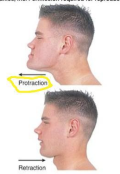
Jutting and retracting the head and neck — a common but unnecessary habit when securing the instrument.
Jutting the chin and neck forward puts the body in an unnatural position that is difficult to sustain without creating stress and tension over time. Beginners often ignore the discomfort in the moment because it seems like the only option — but it is not.
Try this simple observation: without holding the violin, jut the neck and head forward in relation to the shoulders, then allow them to relax back to a neutral position. Notice the immediate difference in comfort and ease. The head should rest on the chinrest with its natural weight — not be pressed or jutted forward.

William Primrose resting his head naturally on the viola — a beautiful example of ease and balance with no visible tension in the neck or jaw.
Karen Tuttle, who studied with William Primrose and carried forward his principles of natural ease, was particularly attentive to the relationship between the head, neck, and jaw. She noted that tension in the jaw and neck was among the most insidious forms of physical interference in playing — often invisible to the player themselves. Tuttle encouraged students to imagine the head floating freely on top of the spine, resting into the chinrest rather than pressing against it. This image of release into rather than pressing against is a powerful reframe for players struggling with this misconception.
Misconception 3: The Right Shoulder Is the Fulcrum from Which the Bow Stroke Derives
In fact, the shoulder goes along for the ride. While it is true that the shoulder does not remain motionless — it may rise and fall slightly — it is part of a larger set of physical mechanics and moves in response to other muscles and skeletal movements rather than initiating them.
The real source of the bow stroke lies deeper — in the back muscles, particularly those surrounding the scapula. Getting in touch with back involvement can feel elusive at first, but a simple exercise helps: place the right hand on the left shoulder, then elevate the right elbow. This Chicken Wing movement makes it easy to feel the muscles working under the scapula — the same muscles that should be engaged, not the shoulder itself, in the bow stroke.
D.C. Dounis, the influential Greek physician and string pedagogue whose work profoundly shaped modern violin and viola technique, wrote extensively about the role of the larger muscle groups in bow production. In his Artist's Technique of Violin Playing (Op. 12), Dounis emphasized that the bow arm must be understood as a unified system — one in which the larger muscles of the back and upper arm initiate and guide the stroke, while the smaller muscles of the forearm and hand respond and refine. He was deeply skeptical of any approach that isolated the shoulder as the primary driver, arguing that this led to rigidity and a loss of tonal freedom. For Dounis, the bow stroke was fundamentally a whole-body event, rooted in the back and transmitted through a free, responsive arm.
Misconception 4: The Right Hand Position Is Static and Never Changes

Exploring balance in the bow hand.
The idea of balance versus grabbing is one of the most important challenges for students to tackle. The bow hand and fingers are constantly reacting to which part of the bow is being used — and this constant, subtle adjustment is what makes real bow control possible. A person walking a tightrope could never do so by clinging rigidly to the rope with their toes; the same principle applies to the bow hand.
This responsiveness is most obvious in strokes like spiccato, where the fingers visibly react to the back-and-forth of the bow. But it is equally present in detache and legato — the hand is always responding, always adjusting.
Dounis devoted much of his pedagogical work to the independence and flexibility of the bow fingers. His Daily Dozen (Op. 11) and other exercise collections are built on the premise that the fingers must develop an almost improvisational responsiveness — never locked, never static. He described the ideal bow hand as one in which the fingers act as living shock absorbers, constantly micro-adjusting to maintain contact, tone, and control. This is precisely the opposite of a fixed or rigid hand position.
A simple motion study to feel this:
- Take the bow and play a short down bow using only 2 inches of bow at the frog.
- Hover the bow above the string and extend the arm to the tip.
- Play a short up bow using only 2 inches at the tip, then travel back to the frog while hovering.
- Repeat several times, noticing how the hand and arm learn to balance in relation to the bow at each end.
The less judgment about the wobbly moments, the better the brain can absorb the kinesthetic information it needs to make adjustments naturally.
Misconception 5: The Index Finger Bears Most of the Weight in the Right Hand
If the bow is truly balanced in the right hand, the pinky bears the lion's share of the weight at the frog, while the index finger absorbs most of the weight at the tip. This is a teeter-totter relationship — and understanding it changes everything about how the bow hand is used.
A simple pencil study makes this tangible: hold a pencil as you would a bow, and straighten the pinky to cause the tip to point upward, perpendicular to the floor. Then notice how leaning the index finger against the pencil causes the tip to point downward toward the floor. This is exactly the kind of constant, responsive balancing that the right hand performs throughout the bow stroke — and it is the index finger's balancing role, not a gripping or pressing role, that matters most.
Both Dounis and Tuttle addressed the dangers of index finger dominance, though from slightly different angles. Dounis cautioned against what he called pressure playing — the habit of pressing the index finger into the bow as a substitute for the natural weight of a free arm. He argued that true tone production comes not from pressing but from the weight of a released, coordinated arm finding its way to the string through a flexible hand. Karen Tuttle echoed this in her concept of coordination: when the arm is truly free and the body is working as a whole, the index finger does not need to press — it simply participates in the natural flow of weight from the back, through the arm, and into the bow. The result is a tone that is both powerful and singing, without the fatigue and constriction that pressure playing inevitably produces.
by Rozanna Weinberger
0 comments